
Home/What We Treat/Bunions
Minimally invasive bunion surgery in Boise and the Treasure Valley
Bunion Treatment and Minimally Invasive Surgery in Boise, Idaho and the Treasure Valley
A bunion is a bone that has drifted out of position. No pad, splint, or cream moves bone. Here is what actually helps, and what correction involves when you are ready.
Most new patients are seen within a few days.

Staged on weight-bearing X-rays
An evaluation maps your options and does not commit you to surgery.
Minimally invasive correction
SERI and MICA techniques, with small marks rather than a long scar.
Walking from the start
A protective CAM boot from the start of recovery, and regular shoes at around week 7.
One doctor, start to finish
The surgeon who examines you operates and sees you at every follow-up.
Bunions
What a bunion actually is
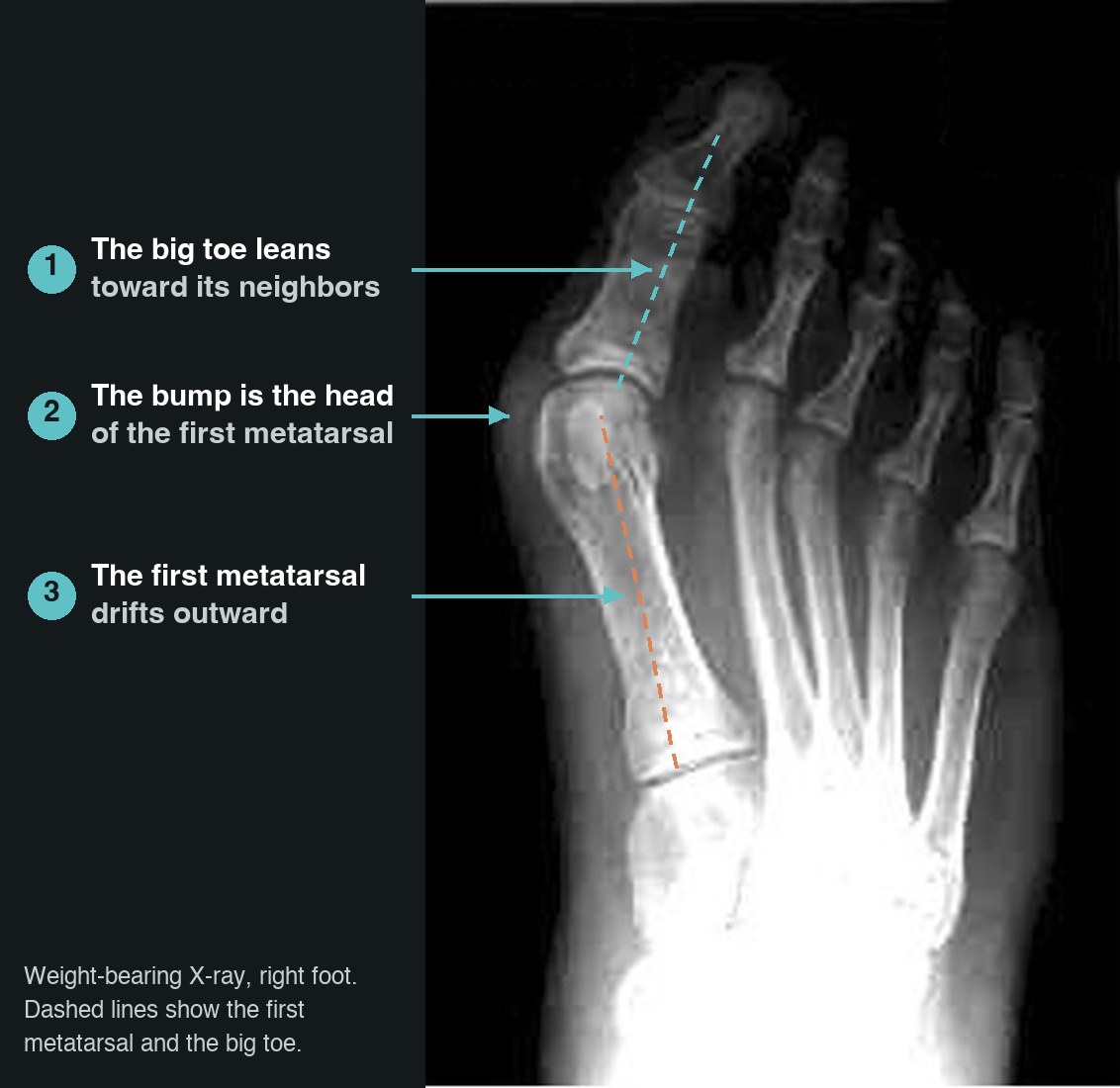
A bunion, known medically as hallux valgus, is not a growth of extra bone and it is not a callus. It is a progressive structural shift. The long bone behind your big toe, the first metatarsal, drifts outward while the big toe leans inward toward its neighbors. The bump you see is the head of that drifting bone pressing against the skin.
Because a bunion is a bone alignment problem, it behaves like one. It does not dissolve, it does not respond to creams, and no device worn on the outside of the foot can push a bone back into position and keep it there. The moment you stand, your body weight goes back to work on a joint that is out of position.
Bunions are progressive. The mechanics that created the drift keep operating, which is why the bunion you have watched for ten years is bigger than it used to be. The most common driver is inherited foot structure. Narrow shoes accelerate it and inflame the joint, but they are rarely the whole story.
Symptoms
Bunion symptoms that bring people in
Pain over the bunion itself
Difficulty wearing shoes comfortably
Pain beneath the ball of the foot
Callus forming under the forefoot
Pain with walking, running, or prolonged standing
Toe deformities that are visibly progressing
Pain in the front of the foot has several possible sources, and they frequently travel together. A drifting big toe crowds its neighbors into hammertoes, offloads weight onto the ball of the foot causing metatarsalgia, and can irritate the nerves between the toes producing the burning and numbness of a Morton’s neuroma.
The goal of the evaluation is to determine why your symptoms developed, not simply where they hurt. An accurate diagnosis is the foundation of successful treatment, and forefoot pain is an area where assuming the obvious answer gets it wrong often enough to matter.
Related: hammertoes, Morton’s neuroma, ball of foot pain (metatarsalgia).
Stages
How bunions progress
Mild
A small bump with occasional soreness in snug shoes. The joint still moves well. Conservative care is at its most effective.
Moderate
The bump is obvious, aching is regular, and the big toe visibly leans toward the second. Shoe options shrink.
Severe
The big toe crowds, overlaps, or tucks under the second. Pain occurs even in wide shoes, and the ball of the foot may hurt from carrying load the big toe no longer accepts.
With arthritis
Years of the joint working out of position wear the cartilage. Treatment now has to address both alignment and joint damage.
What You Have Tried
What you have probably already tried
The honest assessment: several genuinely help with pain, and we will build on the ones that do. None of them move bone. A splint can hold your toe straight while you sleep, but that correction disappears the moment you stand.

What conservative care can honestly do is reduce pain, slow progression, and buy years of comfortable function. Many patients do very well with shoe modifications, orthotics, and activity changes, and for them that is the whole treatment.
When to Come In
When to get a bunion looked at
When bunion pain shows up most days rather than only after long ones. When you have rotated through wider shoes, pads, and inserts without lasting relief. When the bump is visibly growing or the big toe is crowding the second. When the ball of your foot or your smaller toes have started hurting too. When you are declining walks, hikes, or shoes you love because of your foot.
An evaluation does not commit you to surgery. It gets you weight-bearing X-rays, a stage, and a full map of your options, most of which do not involve an operating room.
Find out what stage your bunion is actually at.
Call 208.361.3668.
Evaluation
What a bunion evaluation includes
Your evaluation may include a detailed medical history, physical examination, gait and biomechanical assessment, weight-bearing X-rays, and a footwear evaluation.
Advanced imaging is recommended only when clinically indicated.
Treatment Options
Bunion treatment options
Not every bunion needs surgery. The goal is the least invasive treatment that provides the best long-term outcome, progressing from conservative care to advanced non-surgical options and, when appropriate, surgery. Every recommendation is built around your diagnosis, activity level, lifestyle, and goals.
Non-surgical care
Education and activity modification
Understanding what is actually happening changes what you do about it.
Shoe modifications
Specific guidance on toe box shape, materials, and brands that fit your foot, because “buy wider shoes” is advice, not a plan.
Padding and offloading
Targeted relief for the bump and for the ball of the foot.
Custom orthotics
Prescription orthotics address the mechanics driving the drift, reduce pressure across the joint, and slow progression. They are also how a surgical result gets protected afterward.
Non-surgical care: rehabilitation and pain relief
Stretching and rehabilitation
A progressive program for foot strength and mechanics.
Anti-inflammatory treatment and injection therapy
Anti-inflammatory treatment when appropriate, and injection therapy, which can relieve pain for selected patients.
Class IV laser therapy
Class IV laser therapy for appropriate soft tissue conditions, using the Remy laser in the office.
A note on regenerative treatment and bunions: shockwave, PRP, and similar treatments are aimed at degenerated soft tissue. They do not realign bone, and they are not a substitute for correcting a structural deformity. Injection therapy can provide non-surgical relief from bunion pain, but it will not correct the deformity, and the pain may return. Being straight about that is why you can trust what the regenerative medicine page says.
Bunion Surgery
Minimally invasive bunion surgery
For carefully selected patients, minimally invasive correction realigns the bone through much smaller incisions with less soft tissue disruption. Less disruption generally means less swelling, less postoperative pain, and small marks rather than a long scar.
SERI technique
Dr. Moyer’s preferred approach for many patients is the SERI technique, which corrects the bone through a small incision and holds it with a temporary wire that is removed in the office during recovery. Many patients choose it because no permanent hardware is left in the foot.
MICA technique
He also performs the MICA technique (minimally invasive chevron and Akin osteotomies), which holds the correction with two screws placed using a wires-first technique.
The appropriate procedure depends on the severity of the deformity, joint stability, the presence of arthritis, your activity level, and your long-term goals. The objective is not simply to straighten the toe. It is to restore function and relieve pain.
Patients researching minimally invasive surgery often ask how many procedures their surgeon has performed. Ask Dr. Moyer. He shares his numbers with every patient when surgery is discussed.
Other surgical options
Traditional reconstructive procedures
For certain deformity patterns, degrees of severity, and bone quality, an open procedure remains the better-matched tool, and it is chosen when it is right rather than by default. Recovery after an open procedure tends to be longer. Being told honestly that your bunion needs an open approach is better than being talked into a technique that does not fit it.
No single technique is best for every bunion, and a surgeon who offers only one will naturally find that everyone needs it.
Combined with hammertoe correction
Because a drifting big toe crowds its neighbors, many patients benefit from straightening a hammertoe in the same procedure. One anesthetic, one recovery.
Recovery
What recovery from bunion surgery looks like
This is the typical schedule after minimally invasive correction. You will know your own plan before you choose a surgery date.
One foot at a time
Dr. Moyer usually corrects one foot per surgery.
Walking from the start
You walk in a CAM boot, a protective walking boot, throughout the early weeks of recovery.
Week 1
First follow-up visit.
Week 2
Stitches come out.
Week 5
The temporary wires are removed in the office.
Week 7
Back into regular shoes. For most patients this is the final post-operative visit.
Physical therapy is not usually needed.
Return to most activities follows over the coming months, with high-impact sport cleared last. Residual swelling after long days can persist for months and is normal.

Why Riverside
Why patients choose Riverside
Riverside Foot and Ankle is Dr. Dustin Moyer’s practice, and that is not a technicality. You see him at every visit, he performs your procedure himself, and he handles your follow-up. Dr. Moyer graduated from Eagle High School and Boise State, trained and practiced in the Seattle area, and came home to build the kind of practice he wanted to work in: evidence-based, unhurried, and honest about what treatment can and cannot do. The newest tools are used when the evidence supports them and skipped when it does not.
Specific to bunions: care here combines biomechanics, sports medicine, evidence-based decision making, and modern surgical technique when it is appropriate. The surgeon who examines you is the surgeon who operates and the one who sees you at every follow-up. Because more than one technique is on the table, the procedure gets matched to your X-ray rather than your X-ray getting matched to the procedure on offer. The goal is to help you walk comfortably, stay active, and avoid unnecessary surgery wherever possible.
Advanced, evidence-based, restorative care.
FAQ
Bunion questions
Do bunions always require surgery?
No. Many patients do very well with shoe modifications, orthotics, and activity changes, sometimes indefinitely. Surgery is for pain and functional limitation that conservative care has not solved, not for the appearance of a bump.
Can I fix a bunion without surgery?
You can reduce the pain and slow the progression, often for years. What you cannot do without surgery is move the bone back. Any product promising non-surgical correction of the deformity itself is overstating what it does.
Do bunion splints and correctors work?
They can ease discomfort and are harmless to try. They do not correct the deformity, because the correction disappears the instant you stand and put your weight through the joint.
Am I a candidate for minimally invasive surgery?
It depends on the severity of the deformity, how stable the joint is, whether there is arthritis, your activity level, and your long-term goals. That is what the exam and weight-bearing X-rays determine.
Will there be hardware left in my foot?
It depends on the technique. With the SERI technique, the wire that holds the correction is temporary and comes out in the office during recovery. Other techniques use small screws that stay in place. Which one fits your bunion is part of the surgical discussion.
Can bunions come back?
Any correction can recur over time. Careful procedure selection and good postoperative care substantially reduce that risk, and orthotics and footwear habits afterward protect the result, because the inherited mechanics that built the first bunion are still yours.
How painful is bunion surgery?
Considerably less than its reputation, which mostly dates from procedures performed decades ago.
How soon can I walk?
Most patients walk in a protective CAM boot from the start of recovery and are back in regular shoes at around week seven. You will know your specific plan before you choose a surgery date.
Can you do both feet at the same time?
Dr. Moyer usually corrects one foot at a time. The timing of the second foot is part of your surgical plan.
Will I need physical therapy?
Usually not. Most patients recover without formal physical therapy, and you will be told if your case is an exception.
Can custom orthotics help?
Many patients benefit from improved biomechanics and pressure redistribution, both before surgery and after it. Orthotics do not straighten the toe, and they are not offered here as though they will.
My bunion does not hurt. Should I fix it anyway?
Generally no. A painless bunion that is not interfering with your life does not need surgery and you will not be pushed toward one. It is worth monitoring and worth addressing the mechanics.
Should I see a podiatrist or an orthopedic surgeon?
Podiatric surgeons operate on feet and ankles exclusively, so bunion correction is a core procedure rather than an occasional one. Podiatry also manages everything around the surgery, from orthotics through follow-up, in one place.
What happens if I put it off?
Bunions progress. The toe drifts further, the ball of the foot takes load it was not built for, hammertoes can form, and arthritis can set into the joint. The operation needed in five years is often bigger than the one needed now.
Is bunion surgery covered by insurance?
Typically yes when medically necessary, meaning documented pain and functional limitation rather than appearance alone. Insurance participation is being finalized as the practice opens.
Next Steps
Where to go from here
Not sure you need surgery?
Most people who come in do not, at least not yet. Come find out where you actually stand.
Call (208) 361-3668Pain in the front of your foot that might not be the bunion?
Forefoot pain has several causes and they travel together. The exam sorts them out.
Schedule an ExamTalk to Riverside Foot and Ankle
New patients are welcome, and most are seen within a few days.
Riverside Foot and Ankle, 671 E Riverpark Ln, Ste 110, Boise, ID 83706 · Get directions
Other Conditions We Treat
© 2026 Riverside Foot and Ankle, PLLC · 671 E Riverpark Ln, Ste 110, Boise, ID 83706 · (208) 361-3668