
Home/What We Treat/Regenerative Medicine
Advanced options in Boise and the Treasure Valley
Regenerative Medicine for Foot and Ankle Pain in Boise, Idaho and the Treasure Valley
Treatments aimed at the tissue itself rather than only the pain. Here is what each one is, what the evidence currently shows, and who tends to be a good candidate.
Most new patients are seen within a few days.

Devices in the office
SoftWave shockwave, Remy Class IV laser, red light therapy and ToeFx photodisinfection.
Injection options
PRP made from your own blood, and amniotic and umbilical tissue products including Wharton's jelly.
Between conservative care and surgery
Generally considered when conservative care has been tried and has not worked.
A quote for your plan
Generally not covered by insurance. You get a quote specific to your treatment plan.
Regenerative Medicine
What regenerative medicine actually means
Most conventional treatment for a painful tendon or fascia works by reducing inflammation and offloading the tissue so the body can do its own repair. That works well, and it is where treatment should start.
Regenerative approaches take a different angle. Rather than quieting the symptom, they aim to stimulate a biological response in tissue that is stuck in a continuous cycle of inflammation, or in a chronic injury. By the time someone seeks help, chronic tendon and fascia problems are frequently degenerative, meaning the tissue has become disorganized and has essentially given up on repair. That is why an anti-inflammatory that helped in week two does nothing in month eight: the problem has changed, and the body has adapted to the anti-inflammatory medication or the steroid injection.
Regenerative medicine fits between conservative care and surgery. These treatments are generally considered when conservative care has been tried and has not worked, and when the alternative under discussion is surgery.
Being straight with you about the evidence: this is an area of active research. Some of these treatments have substantial supporting evidence, others have promising but still-developing evidence, and results vary between patients in ways that are not fully predictable. Anyone who tells you a regenerative treatment is guaranteed is telling you something the science does not support.
That is true of medicine generally. Regenerative treatments are treatment modalities, like surgery, and none of them comes with a guarantee. Surgery does not guarantee complete resolution of your symptoms either, and it is not the only treatment available. Dr. Moyer will share the research with you so you can review it on your own, and talk through your goals and expectations before anything is decided.
Treatment Options
Regenerative treatments we offer
Extracorporeal shockwave therapy (ESWT)
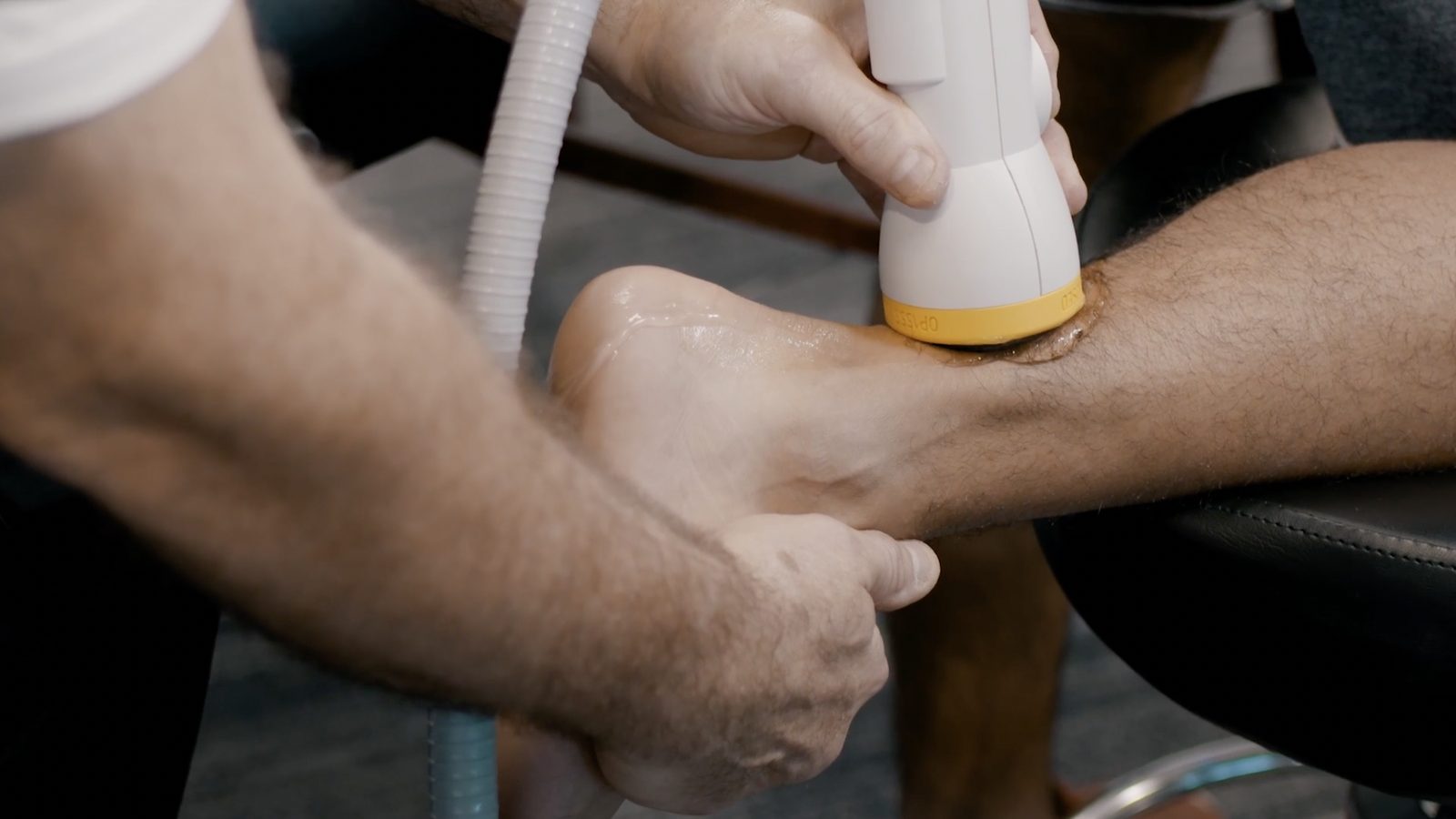
Shockwave delivers acoustic pressure waves through the skin into the target tissue. The mechanical stimulus prompts a local biological response in tissue that has become chronically degenerated. It has been used internationally for about twenty years, including in professional sports medicine, and the technology has improved over that time. The practice uses a SoftWave device.
What the appointment involves
A handpiece applied to the area for several minutes. No needles, no anesthetic, no medication. Most patients describe it as uncomfortable rather than painful, and there is no downtime. A typical course is one session a week for four weeks, followed by a four-week pause to evaluate the response.
Where the evidence is strongest
Chronic plantar fasciitis, Achilles tendinopathy, and bone stress injuries, also called stress fractures, each supported by a substantial body of published research.
Cost
Generally not covered by insurance. You get a quote specific to your treatment plan.
About 20 years
of international use, including in professional sports medicine
Once a week for 4 weeks
a typical course, followed by a four-week pause to evaluate the response
Remy Class IV laser therapy
The Remy is a Class IV laser used for several different jobs: heel pain, soft tissue pain in the forefoot and rearfoot, Achilles tendinitis, muscle strains, plantar warts, and fungal nails. It is one device with interchangeable applicator tips, which is how a single laser covers such different treatments. For fungal nails, nail lasers are FDA-cleared for the temporary increase of clear nail.
What the appointment involves
A handpiece applied over the treatment area. No needles and no downtime. How it feels depends on what is being treated: treating a wart feels different from treating soft tissue pain.
Light-based treatments
Red light therapy (photobiomodulation)
A light-based treatment for soft tissue and musculoskeletal pain, available in the office. No needles, no discomfort, and no downtime.
ToeFx photodisinfection
A light-activated treatment used in the office for nail conditions. No medication, no heat, and no downtime. It suits patients who cannot take an oral antifungal or would rather not, and it is often combined with debridement and a topical rather than used alone. Covered in full on the fungal toenails page.
PRP (platelet-rich plasma)
PRP uses your own blood. A sample is drawn, spun in a centrifuge to concentrate the platelets, and the concentrate is injected into the target tissue. Platelets carry growth factors involved in the body’s repair signaling, and the intent is to deliver a concentrated dose directly to tissue that has stalled.
What the appointment involves
A blood draw, processing to concentrate the platelets, then an injection under local anesthetic. Dr. Moyer prefers a leukocyte-rich preparation made with a double-spin method, and a typical course is a single injection. Expect soreness for several days afterward, which is expected rather than a complication, and anti-inflammatory medication is typically avoided during that window because it may work against the intended response.
Where it sits
Studied extensively across orthopedics with mixed but generally encouraging results. Preparation methods vary between clinics, which is part of why study results vary.
Amniotic and umbilical tissue products, including Wharton's jelly
Processed products derived from donated placental or umbilical tissue, screened and prepared by licensed suppliers. They contain a matrix of proteins and growth factors, and are used as an injectable in chronic tendon and joint problems. Dr. Moyer works with two suppliers: one provides a standard product, and the other offers products at different concentrations, so the treatment can be matched to the patient’s needs.
Being precise about what these are
These products are acellular or minimally processed tissue products, used for their structural and signaling components. They are not live stem cell treatments. The term “stem cell” is actively debated for these products, and it is not used here. Regulatory oversight has tightened considerably, and any clinic promising stem cell regeneration from these products is describing something the products are not marketed to do.
Where it sits
The evidence base is younger than for shockwave or PRP. Genuinely promising in several applications and genuinely still developing, and you will be told that rather than a more exciting version of it.
Setting Expectations
What regenerative treatments are not
This section exists because the category is heavily oversold, and being the practice that says so is worth more than an extra paragraph of enthusiasm.
Not a guaranteed alternative to surgery
Some patients avoid an operation. Others eventually have one anyway. Which group you fall into cannot be predicted in advance.
Not a first-line treatment for a new problem
A fresh case of plantar fasciitis should be treated with stretching, taping, and orthotics, which resolve most people at a fraction of the cost.
Not instant
These work, when they work, by prompting a biological process that takes weeks to months.
Not all the same
And price does not indicate efficacy.
Not appropriate for everyone
Certain conditions, medications, and infections rule them out.
Find out whether you are actually a candidate.
Call 208.361.3668 or request an appointment online.
Conditions
Foot and ankle conditions where these treatments are used
Chronic plantar fasciitis that has not resolved with conservative care
Achilles tendinopathy
Other chronic tendon problems around the foot and ankle
Bone stress injuries (stress fractures)
Selected soft tissue conditions in the forefoot and rearfoot, including muscle strains
Fungal nail infection, using light-based treatment
Arthritic joint pain, in selected cases
Support during or after surgery, in selected cases

Where a regenerative option is considered, it is generally alongside the mechanical treatment rather than instead of it. Injecting a fascia while leaving the mechanics that overloaded it unaddressed is treating half the problem, which is why orthotics and a rehabilitation program usually accompany any of this.
And to be clear about where these do not apply: regenerative treatments do not realign bone and are not a substitute for correcting a structural deformity like a bunion or hammertoe. They can provide non-surgical relief of the pain that comes with one, but the condition may come back.
Your Consultation
How a regenerative medicine consultation works
Diagnosis first
These treatments are aimed at specific tissue, so establishing precisely what is wrong and where comes before anything else.
An honest assessment of where you are
If you have not completed a genuine course of conservative care, that gets said, and it is usually the better and cheaper starting point.
A discussion of the options, with real numbers
What each treatment involves, the clinical evidence for your specific condition, what it costs, and what the alternatives are including doing nothing. You get time to review it and ask questions. If Dr. Moyer does not know an answer, he will tell you so, find it, and get back to you.
No pressure and no packages sold in the room
You should be able to leave, think about it, and come back.
Why Riverside
Why patients choose Riverside
Riverside Foot and Ankle is Dr. Dustin Moyer’s practice, and that is not a technicality. You see him at every visit, he performs your procedure himself, and he handles your follow-up. Dr. Moyer graduated from Eagle High School and Boise State, trained and practiced in the Seattle area, and came home to build the kind of practice he wanted to work in: evidence-based, unhurried, and honest about what treatment can and cannot do. The newest tools are used when the evidence supports them and skipped when it does not.
Specific to regenerative medicine: you get a straight answer about whether you are a candidate, including the answer that you are not one yet. These treatments are offered as part of a complete plan rather than as a product, with pricing explained up front and specific to your plan rather than presented in a room after a sales conversation. The practice’s stated approach is advanced, evidence-based, restorative care, and evidence-based is the operative word in that sentence.
Advanced, evidence-based, restorative care.
FAQ
Regenerative medicine questions
Does regenerative medicine actually work?
For some conditions and some patients, yes, and the evidence is strongest for shockwave in chronic plantar fasciitis, Achilles tendinopathy, and bone stress injuries. For others the evidence is still developing. The honest answer depends on the specific treatment, the specific problem, and who is administering it, and you will get a straight read rather than a blanket yes.
Is it painful?
Shockwave is uncomfortable during treatment and over quickly. Light-based treatments like ToeFx and red light therapy involve no discomfort at all. Laser treatment depends on what is being treated: a wart feels different from soft tissue pain. These devices were chosen in part because patients tolerate them well. Injection treatments involve a needle and local anesthetic, and the area is typically sore for several days afterward.
How many treatments will I need?
It varies by treatment and condition. A typical shockwave course is one session a week for four weeks, followed by a pause to evaluate. PRP is usually a single injection.
Does insurance cover this?
Generally not. Most plans classify these as investigational, which is why they are cash services. Rather than a one-size-fits-all price list, you get a quote specific to your plan, because shockwave, red light therapy, and an injection are each priced differently.
Is this stem cell therapy?
No, and it is worth being precise. PRP uses concentrated platelets from your own blood. Amniotic and umbilical products are processed tissue products used for their structural and signaling components. Neither is a live stem cell treatment. The term is actively debated for these products, and clinics advertising them that way are describing something these products are not.
How long until I know if it worked?
Weeks to months rather than days, because these work by prompting a biological process. A course of shockwave is often assessed some weeks after the final session.
Can I take ibuprofen afterward?
After injection treatments, generally not for a period, because anti-inflammatory medication may work against the intended response. You will get specific instructions.
Will this fix my bunion?
No. Injection therapy can provide therapeutic relief from bunion pain, but it will not correct the deformity. Anyone offering an injection to correct a bunion is overselling it.
Can these treatments be used with surgery?
Yes, in selected cases. Growth factor treatments can be given during or after surgery, with the aim of supporting healing and recovery. Whether that makes sense for you is part of the surgical plan.
What if it does not work?
Then you have a conversation about what is next, which may be a different regenerative option, a mechanical approach that has not been fully tried, or surgery. Nothing here closes a door.
Should I try this before surgery?
Often it is reasonable to, particularly for chronic tendon and fascia problems. It is not a guarantee of avoiding surgery and you will not be told it is.
Am I too old for this?
Age alone is rarely the deciding factor. Your overall health, the tissue involved, and how long the problem has been present matter considerably more.
Next Steps
Where to go from here
Ready to find out if you are a candidate?
Request an appointment online or call 208.361.3668.
Make an AppointmentStill in the early stages of a problem?
Start with conservative treatment. It is cheaper, faster, and works for most people.
Call (208) 361-3668Been told surgery is your only option?
A second opinion that includes these options is worth an hour of your time.
Request a Second OpinionTalk to Riverside Foot and Ankle
New patients are welcome, and most are seen within a few days.
Riverside Foot and Ankle, 671 E Riverpark Ln, Ste 110, Boise, ID 83706 · Get directions
Other Conditions We Treat
© 2026 Riverside Foot and Ankle, PLLC · 671 E Riverpark Ln, Ste 110, Boise, ID 83706 · (208) 361-3668